Revolutionizing A Drift Machine via Actionable Insights from a Comprehensive Drift Setup Software
Within the intensely competitive world of contemporary professional sliding, success is not merely solely a product of raw torque or driver aggression. Instead, it has evolved into a complex discipline which demands a painstaking fusion of choosing a time-tested chassis, outfitting it with the highest-quality drift-spec parts, and, most critically, comprehending its live behavior on the course through cutting-edge vehicle dynamics analysis tools. This exhaustive guide functions as your master plan from the very first idea of a drift build right through to the last telemetry-optimized tweaks that turn a capable vehicle into a consistent podium finisher. We will examine in detail the art and science of vehicle alignment optimization, showing how a modern vehicle dynamics tool like precise measurement hardware eliminates assumptions and provides unmatched clarity into your chassis's true performance.
The cornerstone of any successful drift machine is, without question, the base vehicle itself. Certain platforms have earned renowned reputation within the global oversteer scene due to their inherent handling characteristics, robust build quality, and the enormous range of aftermarket support available. Choosing the optimal car is the first and most important decision a enthusiast will make. For instance, the BMW E36 is widely regarded as perhaps the the greatest overall drift cars of the modern era. Its excellent balanced front-to-rear weight, coupled with a rear-wheel-drive configuration and bulletproof six-cylinder engines, forms a platform that is at once accessible for newcomers and incredibly competitive in the possession of a pro pilot. The successor of this lineage, the BMW E46, improves on these attributes with a even more refined structure, broader track for enhanced stability, and even more turning capability straight from the manufacturer. A different dominant platform in the pro scene is the Chevrolet Corvette C6.
This American sports car brings a unique combination of advantages to the sideways world, featuring a lightweight alloy chassis, a backwards-positioned gearbox and differential unit that contributes to an excellent front-to-rear mass ratio, and the tremendous thrust of a big LS-series V8 engine. This fusion transforms it into an absolute monster on track, capable of entering and sustaining long drifts with relatively effortless use of acceleration. For drivers seeking exceptional bang-for-the-buck, the Nissan 350Z stands out as a excellent example. It is delivered from the manufacturer with a stiff body structure, a competent original limited-slip differential, and the free-revving V6 motor that provides sufficient horsepower and torque for learning and progressing in the sport. Its follow-up, the Nissan Z34, offers more advancements in chassis stiffness, suspension design, and outright motor output, cementing its position as a favorite pick among competitive pilots. Other historic platforms that merit consideration encompass the lightweight unique FC generation RX-7, the most popular Nissan S13, the American Ford Mustang SN95, the more recent BMW E90, and the tiny yet unbelievably fun and instructive MX-5 Miata. Each of these platforms offers a unique set of characteristics, challenges, and potentials, but they all possess the core ingredients required to become a competitive sliding vehicle.
However, choosing the right chassis is merely the first step. To unlock the true performance of every of these vehicles, significant modifications to the steering system and suspension systems are completely non-negotiable. This is where the world of performance tuning hardware comes into critical importance. The single most transformative improvement for a purpose-built competition vehicle is the installation of a drift-spec steering angle kit. These engineered assemblies, like those manufactured by industry leaders like SLR Speed, are designed to dramatically increase the vehicle's available lock-to-lock rotation. A standard production vehicle is severely limited in how far its steering tires can pivot, a design limitation for public road use. In oversteer driving, however, aggressive opposite lock is frequently necessary to catch and hold a drift. An steering kit substitutes the OEM uprights, tie rods, and sometimes A-arms with pieces that permit the front tires to reach degrees of turn in excess of 70 or even 80 degs, compared to a typical stock setting of around 40 to 50 °.
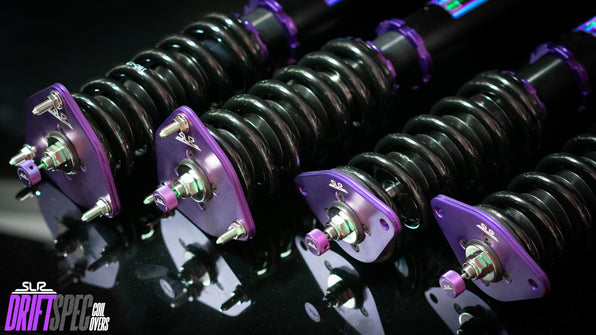
This tremendously increased capability provides the pilot with significantly more command during a drift, enabling it to be considerably simpler to initiate a slide, hold it through a extended turn, and transition smoothly from one side to the other. The improvement in drivability is nothing short of profound. Coupled with a appropriately specified angle kit is the equally critical modification to the chassis's damping system. Off-the-shelf or including high-end road coilovers are generally not engineered for the particular and brutal requirements of sliding. A dedicated pair of coilovers is paramount. These specific dampers have custom damping rates and spring strength that are optimized for the rapid load shifting that is inherent of sliding. When a pilot begins a angle, the car's inertia is thrown rapidly to the outside of the turn. Proper drift-spec dampers manage this movement in a predictable way, allowing the car to settle rapidly and providing the operator precise feel through the controls and seat. They furthermore enable accurate tuning of ground clearance, damping stiffness, and weight balance, which are all integral parts of optimizing the car's dynamics to a given track or competition technique. In combination, a high-quality steering angle kit and a expertly selected system of competition coilovers are the undeniable hardware base upon which all subsequent tuning is built.
Once the essential hardware is fitted, the next critical phase in the project is the meticulous setting of the car's wheel angles. This is the world of chassis dynamics adjustment, a methodology that can feel intimidating to the newcomer but is, in reality, the secret to transforming a assembly of fast components into a unified and controllable vehicle. The most critical aspect of suspension geometry for oversteer is certainly camber angle. Camber is the tilt of the rim in relation to the perfectly straight axis when observed from the front of the chassis. If the upper part of the tire is leaning inward, this is referred to as camber-in. In drifting, inward-leaning wheels on the front wheels is widely used and is seen as necessary. The logic is intrinsically related to vehicle dynamics.
When a vehicle is turning at extreme angles, the body tilts toward the external of the corner. This body roll forces the outside front tire to diminish its ideal footprint with the tarmac. By introducing negative camber, the wheel is pre-tilted to counteract this tilt. As the vehicle leans into the bend, the tire flattens out on the road surface, optimizing suspension engineering its grip at the exact point when it is most required for directional command. Typically, front axle adjustments for a serious sliding vehicle vary from approximately -3 degrees to as high as -5 degrees or even greater, contingent on the details of the vehicle setup, rubber type, and operator preference. The rear axle tires also employ negative camber, but the angles are usually more modest and more nuanced than the front. Too much inward lean at the rear can result in the chassis extremely tail-happy and challenging to manage on power use, as it reduces the effective grip area of the driven tires during forward acceleration. Thus, rear adjustments are frequently in the vicinity of -1 degree to -3 degrees, striking a careful balance between giving enough lateral bite to help in starting and maintaining the slide while also keeping effective grip for acceleration the bend. alignment is just one part of the broader tuning equation, which additionally involves toe, self-centering steering, and bump steer adjustment.
Toe angle is the angle of the wheels when looked at from a bird's-eye view. Toe-in means the leading edges of the wheels are nearer together than the trailing edges, while negative toe means the opposite. For sliding, a modest amount of front toe out is often employed to improve the initial steering reaction, making the car feel more responsive and eager to start a drift. Rear toe setting is generally set to neutral or a incredibly minute amount of positive toe to foster stability under throttle. caster angle is the forward or backwards tilt of the suspension pivot when looked at from the side of the vehicle. Positive caster angle improves steering feel and stability confidence, and it also adds to camber increase during cornering, which is extremely useful. Tuning these values is a intricate interplay where a change to one setting can and will affect the others. The conventional approach for dialing in a car's alignment for drifting has long been a tedious affair of trial and error. A pilot or engineering group would introduce a adjustment based on experience, test the car on track, rely on the driver's subjective feel and comments, and then apply a further adjustment. This cycle would repeat again and again until the vehicle felt "good" or the allotted track period was exhausted. This methodology is not only incredibly inefficient in terms of time and tires, fuel, and parts, but it is also deeply imprecise.
Driver sensation is a notoriously inconsistent data source, affected by many factors such as fatigue, varying car alignment tuning track surfaces, temperature, and simply the mindset of the pilot on that given day. What feels "loose" on one run might feel "pushing" on the following pass, leading to contradictory information and counterproductive tweaks. This traditional challenge in car suspension tuning is precisely where contemporary technology has made its mark to transform the landscape.
The rise and application of advanced drift telemetry software has ushered in a radically different age for building and perfecting high-performance drift cars. This new generation of platforms, exemplified by cutting-edge solutions like data acquisition drift angle kits tools, operate by directly capturing the actual physical performance of the vehicle as it is operated on the track. Unlike using personal feedback, these tools collect measurable data on critical factors such as shock absorber movement, wheel speed, G-force loading, steering angle, and accelerator and brake pedal input. This raw information flow is then interpreted by sophisticated software that can plot and interpret the data in a actionable format. For the very first time, engineers and builders can visualize exactly what the car is doing at any given moment of a slide. This function revolutionizes the entire suspension tuning process. Think about the particular task of setting the front axle negative camber for a given vehicle. As an alternative to introducing a modification from -3 degrees to -3.5 degrees and then running multiple laps to try and "feel" a difference, a vehicle dynamics tool can deliver instant and clear data. The application can display in a chart how the tire's loading is behaving during the most important stages of a angle: the initial flick, mid-corner, and changing direction. It can show if the current camber setting is permitting the outside front tire to maintain optimal grip or if the rubber is working inefficiently on its external shoulder.
The software can then suggest data-driven advice for change. Perhaps the data indicates that the outside front tire is still overworking its sidewall at -3.5 degrees of camber, suggesting that an increase to inward lean, say -4 degrees, might be warranted. On the other hand, the data might show that the tread is failing to achieving heat or that the inside edge is wearing excessively, which could point to that there is excessive angle and a modest decrease back to -3.2 degrees would be more efficient. This degree of granularity and useful insight was literally unimaginable in the days of pure manual adjustment.
The effect of employing a comprehensive vehicle dynamics tool goes much further than just setting camber angles. It becomes an priceless coilover setup tips that is specific to your exact vehicle. When setting the damping values on your suspension, instead of depending on general advice or mimicking another car's setup, you can utilize the software to see how the car is performing in reaction to your adjustments. The tool can graph the suspension travel path over a section of track, revealing if the shocks are controlling the body movement optimally or if they are causing the car to oscillate too much after a flick. It can help in diagnosing problems like excessive compression or topping out, allowing you to apply informed choices to helper springs, damping settings, or stance. This process translates similarly to the complex process of corner balancing. Beyond camber, the tool can offer insight into how adjustments to toe settings and caster angle are affecting the car's handling during specific maneuvers of a slide. For instance, it can help you to ascertain the best amount of front toe out for your particular steering configuration and competition style by measuring the quickness of turn-in reaction and the predictability of the chassis at full steering angle. This turns the tool an exceptionally powerful performance optimization handbook that is dynamically updated by the real-world dynamics of your own car on the circuit. It elevates the entire endeavor from a mysterious craft into a scientific engineering exercise.
Moreover, the value of a tool like data acquisition is not restricted to professional engineers with extensive budgets. For the grassroots enthusiast, it serves as an powerful educational tool. It effectively provides the builder with the knowledge of a expert race engineer without the corresponding expense. It speeds up the tuning process by delivering definitive directions to questions that would traditionally take countless track days of experience to understand. A driver can understand how their specific chassis responds to specific settings, developing a deeper understanding of vehicle dynamics in the journey. It additionally makes accessible high-level suspension engineering techniques, permitting all drivers with the ambition to perfect their vehicle to achieve it in a structured and effective fashion. This is especially valuable in a sport like oversteer competition, where tuning know-how has traditionally been a tightly held commodity among professional crews. Now, that power can be in the toolkit of any dedicated driver.
In the final analysis, the process to constructing and dialing in the perfect competitive drift machine is a multi-faceted endeavor that smoothly combines classic hardware principles with 21st-century data solutions. It starts with the strategic choice of a proven platform, followed by the application of critical competition components like drift-spec drift angle kits and expertly valved competition coilovers. The build then advances into the intricate realm of alignment optimization, where parameters like camber angle, toe setting, and caster are carefully adjusted to suit the chassis's new geometry and the driver's specific technique. Finally, and what genuinely differentiates the modern methodology from the past, is the integration of a advanced suspension tuning application. This tool removes the approximation and inefficiency of solely seat-of-the-pants adjustment by providing quantifiable, live information on how the vehicle is truly behaving. It functions as an incredible diagnostic aid, a definitive drift suspension tuning guide, and a master performance analyzer. As a complete package, this integrated philosophy ensures that each and every component of the drift car—from the selection of the chassis to the last tweak on the suspension—is optimized for peak success on the competition venue. It represents the complete evolution of the discipline of sliding, bridging raw car control with surgical chassis dynamics to create the most competitive cars imaginable.